Proof of Time consensus
The Obsidian Proof of Time blockchain uses a target block interval of 5 seconds. Network rules are enforced by node software that verifies every block and transaction.
 MAINNET IS LIVE
Native coin: OBS (Obsidian Seal Coin)
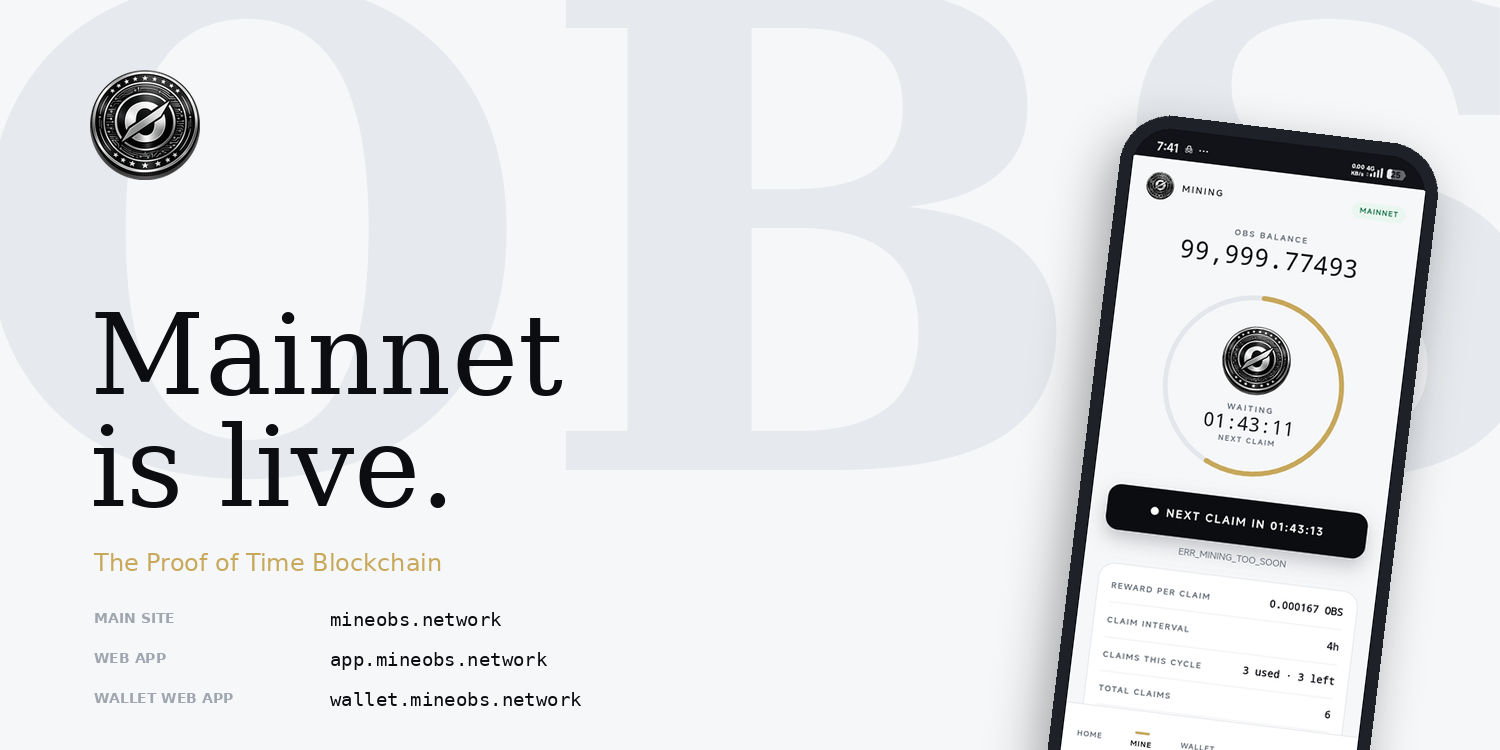
Obsidian Network is a live blockchain built around Proof of Time consensus. Its native OBS coin supports mining claims, wallet transfers, blockchain activity and Obsidian Name Service (.obs) names. Use the official links below to mine, open the Web App, use the OBS wallet or explore the blockchain.
Obsidian Network is a decentralized blockchain. Its consensus design and native mining mechanism are built around protocol claims rather than conventional proof-of-work hash-rate competition. Protocol rules and the blockchain node decide whether actions are valid. The website displays and submits information; it does not decide consensus.
The Obsidian Proof of Time blockchain uses a target block interval of 5 seconds. Network rules are enforced by node software that verifies every block and transaction.
OBS is the native coin of the Obsidian blockchain. It is not an ERC-20 token or a smart-contract token. The protocol enforces a maximum supply of 21,000,000 OBS.
Node runners operate the network. The documented mainnet node RPC port is 8630 and the peer-to-peer port is 8631.
Every product below is an existing, official Obsidian Network service. Each link opens the live application.
Mine OBS through the official mining page. Eligible wallets can make a claim once every four hours, with up to six claims per wallet per 24-hour cycle. Rewards are set by protocol rules and chain state, not by your browser's computing power.
Visit the Mining PageThe user-facing application for supported Obsidian Network features, including account and wallet interaction, mining claims, blockchain activity and Obsidian Name Service management where supported.
Open Obsidian Web AppCreate or restore a wallet, view wallet information, receive OBS, send OBS and sign supported blockchain transactions. Wallet keys are generated in your browser and stored encrypted in local wallet storage.
Open OBS WalletInspect real blockchain data, including blocks, transactions and registered names, on the official explorer.
Explore the BlockchainThe mining schedule below is documented by the Obsidian Network protocol. Your eligibility and the live reward figures are shown in the mining application.
| Parameter | Documented value |
|---|---|
| Claim interval | One claim every four hours when eligible |
| Claim limit | Up to six claims per wallet per 24-hour cycle |
| Initial daily reward at launch participation | 0.001 OBS per day |
| Initial reward per claim | Approximately 0.000166666666666666 OBS |
| Reward adjustment | The reward schedule can decrease as active-miner participation increases, subject to protocol rules and a minimum reward floor |
Important: Mining rewards are not guaranteed income, a fixed market value or guaranteed future rewards. Follow the eligibility requirements shown by the live application at mineobs.network.
Obsidian Name Service (ONS) is the native .obs naming system. It maps a registered name to a wallet address. Name registration and renewal are priced in OBS according to protocol parameters. Ownership operations are governed by blockchain transactions and protocol rules.
Registered .obs names are recorded on the Obsidian blockchain. You can look up registered names in the block explorer.
Search the explorerObsidian Name Service works only with .obs names on the Obsidian blockchain. It is not an ordinary DNS domain registration service.
Node runners help operate the Obsidian blockchain. The documented protocol shares Obsidian Name Service revenue with the node runner reward pool.
According to the project's repository documentation, 90% of Obsidian Name Service registration and renewal revenue goes to the Node Runner Reward Pool. The remaining 10% goes to the protocol treasury.
Name revenue sharing is different from mining rewards. Transaction gas fees are also a separate mechanism. Check the official repository for current node requirements and setup steps.
Read the node documentationThe Obsidian Network repository is for blockchain developers, node operators, exchanges and ecosystem partners. It documents node health and status, network parameters, blocks, transactions, addresses, supply, mining status, Proof of Time information, names and supported RPC routes.
Source code, node documentation and supported API routes are published on GitHub.
Explore Developer ResourcesAnswers about Obsidian Network, OBS Coin, mining, the wallet, the explorer, .obs names and developer resources.
Obsidian Network is a blockchain built around Proof of Time consensus. Its native coin is OBS (Obsidian Seal Coin), and its mainnet is live.
Yes. The project lists its mainnet status as live. Current status is shown at mineobs.network.
OBS, short for Obsidian Seal Coin, is the native coin of Obsidian Network. The protocol enforces a maximum supply of 21,000,000 OBS.
OBS is the native coin of the Obsidian blockchain. It is not an ERC-20 token or a smart-contract token.
Eligible wallets can make a claim once every four hours, with up to six claims per wallet per 24-hour cycle. Rewards are determined by protocol rules and chain state, not by browser computing power. Rewards are not guaranteed.
The OBS web wallet is at wallet.mineobs.network. Never share your recovery phrase or private keys with anyone.
Use the Obsidian block explorer at mineobs.network/explorer/ to inspect blocks, transactions and registered names.
Obsidian Name Service (ONS) is the native .obs naming system that maps a registered name to a wallet address. Registration and renewal each have a documented fee of 0.05 OBS. Names have a one-year term and a 30-day grace period after expiry. Manage names in the Obsidian Web App.
The official GitHub repository at github.com/EmoluxLabs/Obsidian-Network documents the node software, network parameters and supported RPC routes.